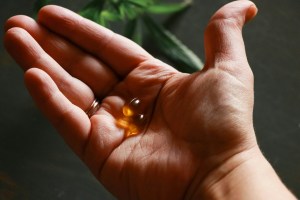
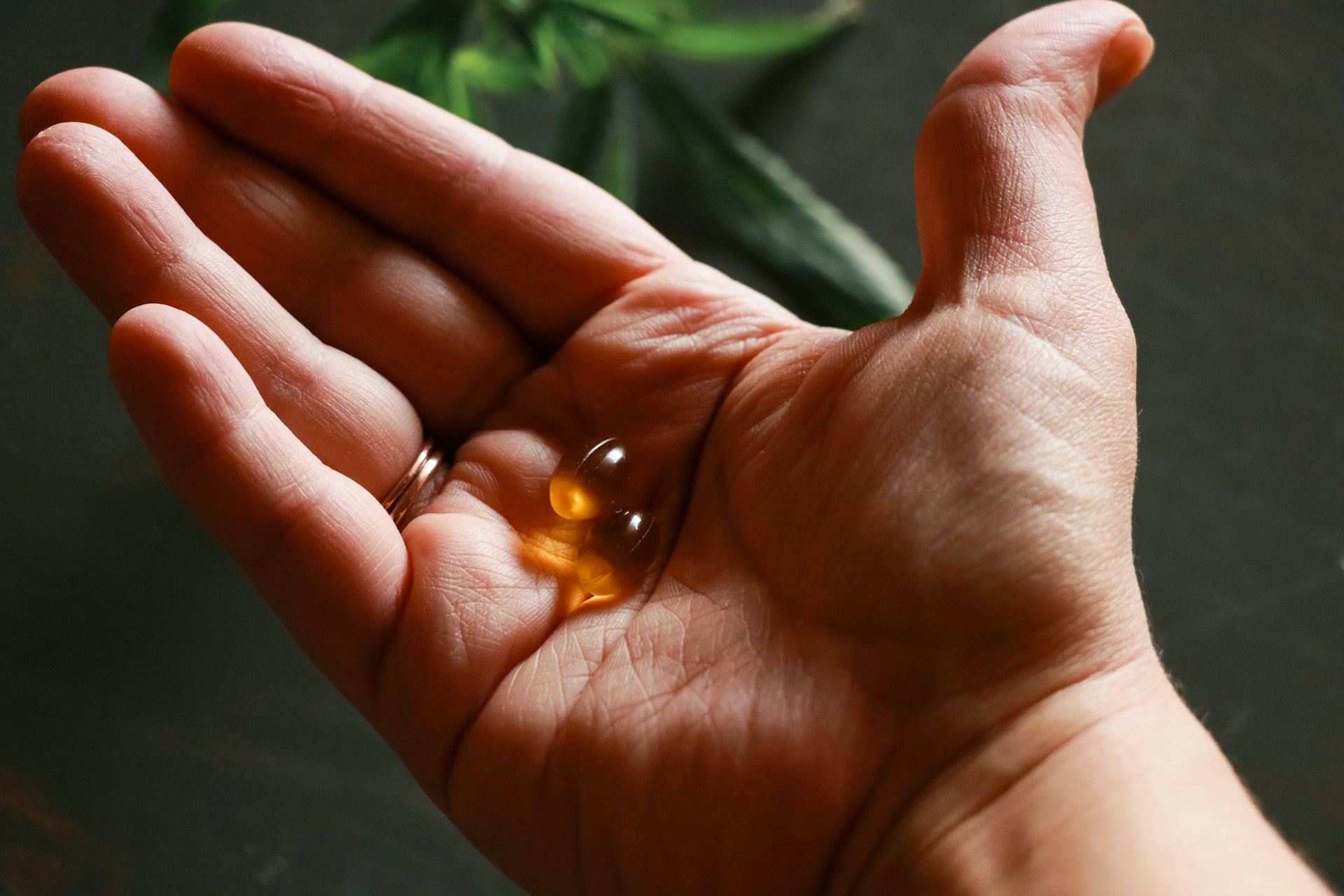
Softgels are the format people reach for when an ingredient is oily, hard to swallow as a tablet, or poorly absorbed in dry form. Fish oil, vitamin D, CoQ10, and most lipid-based actives end up in softgels for good reason: a liquid fill sealed in a flexible shell is easy to swallow, masks taste and odor, and can improve how well certain ingredients are absorbed. But softgels are also the most specialized of the common supplement formats — they’re made on different equipment than capsules or tablets, sized by a unit most brands have never heard of, and they live or die on the chemistry of the fill.
This guide covers how softgels are sized, what can go inside them, how they’re actually made, and what separates a softgel manufacturer that can run your product from one that can’t.
How softgels are sized: minims, not milligrams
The first surprise for most brands is that softgels aren’t sized like two-piece capsules. There’s no “size 00.” Instead, softgel size is measured by fill volume in minims — an old apothecary unit where one minim is about 0.0616 mL, roughly the volume of a single drop. You’ll also see fill volume given in cubic centimeters (cc), which are the same as milliliters. The rough conversion: 1 cc ≈ 16.2 minims.
Across standard softgels, fill volumes run from under 1 minim (about 0.046 cc) at the small end up to 40+ minims (around 2.5 cc) at the large end. Each size is named by its minim count and shape — “4 oval,” “20 oblong,” and so on.
Three shapes cover the large majority of supplement softgels:
Round — spherical, the classic shape for oil-based vitamins like D and E. Round sizes range from roughly 1 to 20 minims. Because they’re symmetrical, they pack efficiently on the production die, which tends to make them quick to run.
Oval — an elongated, slightly flattened sphere. The oval shape adds fill volume without making the capsule much taller, so it stays easy to swallow. Common for multivitamins and fish oil. Ovals range from about 2 to 20 minims.
Oblong — a cylinder with rounded ends (sometimes called capsule-shaped). The slender profile lets you fit a larger dose — a 1000 mg fish oil, for example — while keeping it swallowable. Oblongs run from about 3 up to 24 minims.
Beyond these, manufacturers can produce tubes (for very high fill volumes), twist-off softgels (a tab you twist to release the contents, used for topical or single-dose applications), suppository and pessary shapes, and novelty shapes like fish or animals for children’s products and brand differentiation.
The practical takeaway: you don’t pick a softgel size off a milligram chart. You work backward from your fill volume, which depends on your formula’s density. Two products at the same milligram dose can need different softgel sizes if one fill is denser than the other — so the real first step is having your formula’s fill volume measured, then matching it to a shape and size.
What goes inside: the fill is the whole ballgame
A two-piece capsule mostly holds dry powder. A softgel holds a liquid or semi-solid — and the nature of that fill drives almost every downstream decision.
Oil-based fills (fish oil, MCT, vitamin E, evening primrose oil, lipid-soluble vitamins) are the natural fit and the most common. They’re stable in the gelatin shell and encapsulate cleanly.
Suspensions — a powder active suspended in an oil or lipid carrier — let you put a dry ingredient into softgel form. This is common for actives that benefit from softgel delivery but aren’t themselves liquid.
Hydrophilic and semi-solid fills are possible but more demanding, because anything water-based interacts with the gelatin shell and needs careful formulation to avoid the fill migrating into or degrading the shell.
What you generally cannot do is put a plain dry powder blend into a softgel — that’s what two-piece capsules and tablets are for. If your formula is a dry multi-ingredient blend, a softgel is usually the wrong format, and a good manufacturer will tell you that early.
One precision note worth knowing: softgel encapsulation struggles below about 5 minims (roughly 0.3 mL) of fill, where the risk of leakage and dose non-uniformity rises. Very small fills need a specialized mini-pump and extra process attention. If your dose is tiny, raise it at the first conversation.
The shell: gelatin still dominates, but you have options
The classic softgel shell is gelatin — bovine or fish-derived — combined with a plasticizer (usually glycerin) and water. It’s flexible, seals reliably under heat and pressure, dissolves predictably, and is by far the most established and lowest-cost option. Its limits are the obvious ones: it’s animal-derived (no vegan claim, harder for some dietary requirements), and it’s sensitive to heat and humidity.
Vegetarian/plant-based shells (made from starch, carrageenan, or modified cellulose) exist and are growing, enabling vegan softgels. They cost more, can have a narrower processing window, and sometimes carry longer lead times — so confirm your manufacturer actually runs them before you build a product around the claim.
Either way, the shell can be customized: color and opacity (opaque shells protect light-sensitive actives), and printing with food-grade ink for branding or dose marking.
How softgels are actually made
Nearly all commercial softgels are produced by rotary die encapsulation. In simple terms: molten gelatin is cast into two continuous ribbons; those ribbons feed between two rotating dies; as the dies turn, your liquid fill is precisely injected between the ribbons exactly as the shell halves are pressed and sealed together. The capsules are cut free in the same motion, then tumble-dried and shaped over a drying period before inspection and packaging.
That process explains a few things that matter to you as a buyer:
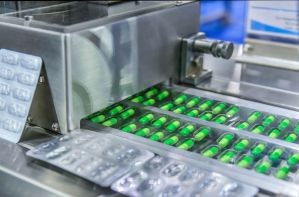
- A softgel line is more equipment than a capsule line. Beyond the encapsulation machine, it needs gelatin melting and dosing tanks, a chiller to cool the gelatin ribbon, a vacuum system to remove air bubbles from the fill, and tumble/tray drying. Not every supplement manufacturer runs softgels in-house for this reason — many outsource it. Ask directly.
- Production speed depends on capsule size. Smaller capsules fit more cavities on the die roller and run faster; large ones run slower. As a real-world illustration, a small oval might run on the order of ~26,000 pieces/hour while a large oval runs closer to ~9,000/hour on the same machine. This feeds directly into your lead time and per-unit cost.
- Drying is a real step in the timeline. Freshly formed softgels need time to dry to the right shell moisture before they’re stable. That’s built into the schedule and isn’t something to compress.
Functional and specialized softgels
If your product needs more than a standard fast-dissolving shell, ask whether the manufacturer offers:
- Enteric-coated softgels — designed to survive stomach acid and release in the intestine (useful for fish oil to reduce reflux/”fish burps,” or for ingredients you want delivered lower in the GI tract).
- Chewable softgels — for children’s products or anyone who won’t swallow capsules.
- Delayed or targeted release via shell modification or coatings.
These are genuine technical capabilities, not defaults — a manufacturer either has them or doesn’t.
What to bring to a softgel manufacturer
To get real answers instead of guesses on your first call:
- Your fill formula and its physical form — oil, suspension, or semi-solid. This determines feasibility before anything else.
- Target dose and, if you have it, the fill’s density or measured fill volume. Without this, capsule size is a guess.
- Shape and size preference, or your swallowability constraints (e.g., “must be easy for older customers”).
- Shell requirement — standard gelatin, fish gelatin, or vegetarian — driven by your label claims.
- Any functional need — enteric coating, chewable, etc.
- Run size and timeline, so capacity, MOQ, and lead time can be mapped to your launch.
How to choose a softgel manufacturer
A few questions cut through quickly:
- Do they run softgels in-house, or outsource them? In-house means tighter control of timeline and quality. Outsourcing isn’t disqualifying, but you should know.
- What shapes, sizes, and shell types can they actually run? Match this to your product, including any vegetarian or specialty shell.
- Can they handle your specific fill? Oil is routine; suspensions and hydrophilic fills require more capability.
- Are they GMP-compliant, with the testing and documentation to prove it? Softgels are a regulated dosage form; you want lot tracking, stability data, and certificates of analysis.
- What’s the realistic MOQ and lead time for your size and run?
Softgels reward getting the format decisions right early — the fill chemistry, the shape, the shell, and whether the manufacturer can run all three together. Alaska Spring Pharmaceuticals manufactures softgels and other supplement formats at a GMP-compliant facility in Westbury, New York, with typical turnaround of 4–6 weeks. If you’d like to turn a fill formula into a concrete softgel spec, reach out to start the conversation.